
Every highway project in India now includes planting. Under the Green Highways Policy 2015, the Ministry of Road Transport and Highways sets aside 1% of highway project costs for planting and upkeep. When it is done well, roadside trees take carbon out of the air for decades. When it is done badly, the plants die within two summers and store almost nothing.
How do trees store carbon?
Trees take in carbon dioxide (CO₂) as they grow. They lock the carbon into their wood, roots and leaves. About half of a tree's dry weight is carbon. Every tonne of stored carbon equals about 3.67 tonnes of CO₂ taken out of the air. So the carbon a plantation stores depends mainly on how much wood it grows. That depends on the type of tree, how fast it grows and how long it lives, and most of all on whether it survives.
Do roadside trees and median shrubs store the same carbon?
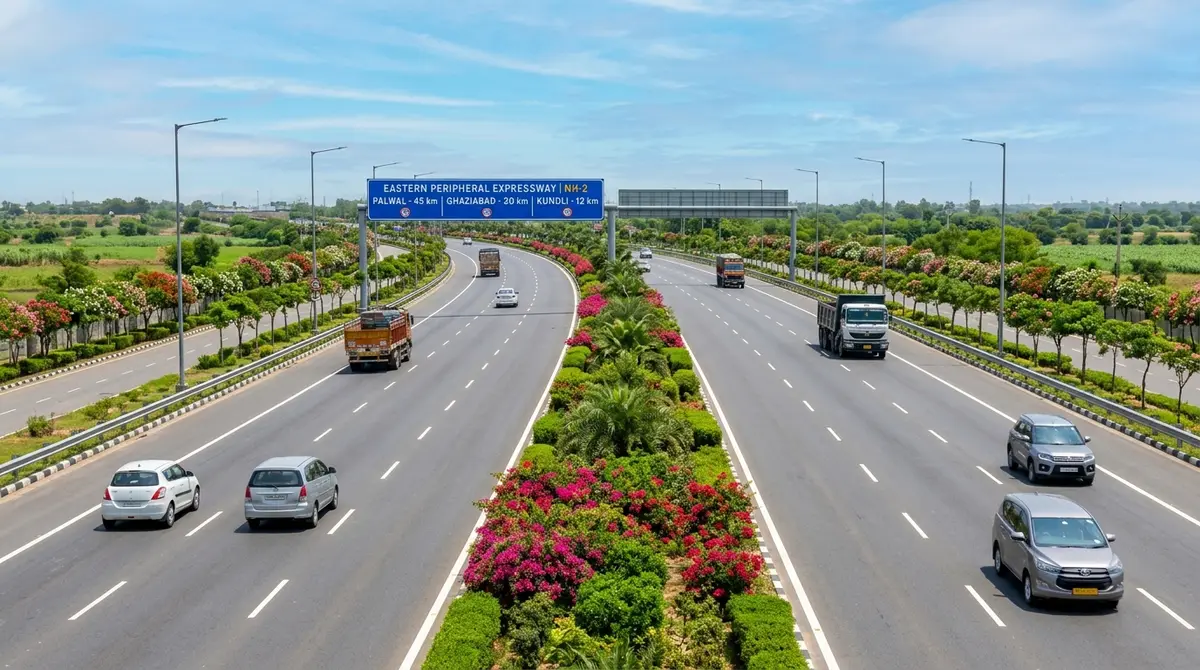
No. The rows of trees along the edges of a road (avenue trees) do most of the carbon work. A large tree that lives long keeps adding wood for decades. Medians are different. They are usually planted with shrubs kept low, to block headlight glare without hiding traffic. So they hold little wood. Medians still matter, but mostly for other reasons.
- Avenue rows: large, long-lived trees. They store the most carbon and give shade to people walking and cycling.
- Medians: thick, low shrubs. They store a little carbon. Their main jobs are cutting glare, catching dust and looking good.
- Green belts beside the road: several rows of tall trees and shrubs, where there is land. They store carbon and screen the road.
Which trees work best in north and central India?
For avenue rows, local trees that handle heat, dust and dry spells do best. Neem, peepal, pilkhan, arjun, jamun, amaltas and kachnar are common choices. Peepal and pilkhan grow large and live long, so they store a lot of carbon. For medians, hardy shrubs such as kaner (oleander) and bougainvillea are widely used. They cope with pollution, heat and little water.
Plant a mix of trees, not one type along the whole road. Then one pest or disease cannot wipe out the plantation. Spacing follows the project rules and road safety rules. Trees must not block the view at junctions or crowd cables and pipes.
How do you measure the carbon a plantation stores?
Good estimates come from measuring trees, not from rough figures per tree. The usual method is:
- Measure each tree's trunk width at chest height (1.3 m) and, if possible, its height.
- Use a published formula for that type of tree to estimate the dry weight above the ground.
- Add the weight of the roots, usually taken as a share of the weight above ground.
- Multiply the total dry weight by about 0.47 (the standard IPCC figure) to get the stored carbon.
- Multiply the carbon by 3.67 to show it as CO₂.
Repeat the measurements every year or two. The difference is the carbon stored in that time. Be careful with headline figures like "kilograms per tree per year". Young roadside trees store very little in their first years, and real numbers vary a lot by tree and site.
A dead sapling stores no carbon. On most roadside plantations, keeping plants alive matters more than how many you plant.
What keeps roadside plants alive?
Roadside plants face heat, dust, damage from vehicles, grazing animals and uneven watering. The plantations that survive usually have these things in common:
- Bigger saplings that have been hardened in a nursery, not small seedlings.
- Tree guards to protect them from animals and vehicles.
- Regular watering through the first two or three summers, ideally with drip lines.
- Quick replacement of dead plants, written into the maintenance contract.
- Moving mature trees instead of cutting them down when a road is widened. A large tree already holds decades of stored carbon that a new sapling would take decades to replace.
Can a plantation earn carbon credits?
Yes, under international standards such as Verra's Verified Carbon Standard or the Gold Standard. But credits need a starting study, long-term monitoring and checks by an outside body. So they usually suit only large projects, or many projects grouped together. In India, the Ministry of Environment, Forest and Climate Change started the Green Credit Programme in 2023, and tree planting is one of the activities it covers. If you want credits, plan the monitoring from day one.
Our work
We planted 3,500 hardy plants that cope with pollution on the NH-7 median for an NHAI contractor. On NH-307 we moved 155 mature trees instead of cutting them down during road widening. See our planting and tree moving services.
Planning Avenue or Median Plantation?
Send us the stretch length, location and specifications. We'll propose species, spacing, a watering plan and a maintenance schedule built for survival.
Book a Site Visit ↗